A Good Book on AI Pricing Ends Right Where Tollbooth DPYC Begins
Share
Rishabh Goel, the founder of Dodo Payments, has published a fifty-five page book called Pricing in the AI Age. It is free. It is good. If you sell anything built on inference, you should read it before you read the rest of this post.
We want to say that plainly at the top, because what follows is a disagreement about scope rather than a disagreement about quality. Goel has done the work. He runs billing for more than sixty thousand AI products across a hundred and fifty countries, and he wrote down what that vantage point shows him. Very few people in payments bother to write the map. He wrote the map.
Our interest is in the edge of it. On page forty-six, near the end, Goel describes a world where AI agents hold their own budgets, exercise their own spending authority, and form their own economic relationships with other AI systems. He says the pricing frameworks for that world do not yet fully exist. He lists AI-to-AI billing among his predictions for 2027 and observes that no standard settlement framework has emerged for it.
He is correct on every count except one. The framework exists. We built it. It is called Tollbooth DPYC, and the reason it works is older than software.
What the book gets right
The core argument is that software pricing broke when marginal cost stopped being zero. For twenty years a seat was a reasonable proxy for value, because adding a user cost almost nothing to serve. Inference changed the physics. Every interaction now carries a real, variable, metered cost, and the customers who love your product most become the ones destroying your unit economics.
The numbers Goel puts behind that are sobering. Traditional SaaS gross margins run in the seventy-five to eighty-five percent range. AI-native products land between thirty and sixty. That is a different business, and it demands a different price.
Four models have consolidated in response. Credit-based pricing, where customers buy a bundle upfront and different actions burn different amounts. Usage-based pricing, metered against tokens or GPU seconds or characters. Outcome-based pricing, where you charge for a resolved ticket or a booked meeting and nothing else. And hybrid, which combines a subscription floor with consumption on top.
Hybrid is winning. Adoption sat around forty-three percent of AI companies and is climbing toward sixty-one percent by the end of this year. Outcome-based pricing, for all the excitement around it, was running at roughly three percent in 2025. Credit-based models were the fastest-growing pricing mechanism in all of software, up a hundred and twenty-six percent year over year.
The book is also refreshingly honest about the parts that hurt. Usage-based pricing invites revenue volatility, enterprise procurement friction, and silent churn, where a customer's consumption drifts to zero over weeks without ever triggering a cancellation event. Outcome-based pricing collapses under three problems: defining the outcome, attributing it between the AI and the humans around it, and forecasting revenue you do not control. Goel tells founders to earn the right to price on outcomes by first delivering them reliably. That is good advice, honestly given.
The craft details worth adopting
Several mechanics in the book are worth lifting whole, and we say so as people who have implemented most of them.
Clay charges its Data Credits only when a lookup actually returns data. Against typical failure rates of twenty to thirty percent, that single design decision materially lowers customer cost and buys enormous trust. Any metered service that debits a customer for a failed call is operating below a standard that its competitors now advertise.
Intercom applies a seventy-two hour confirmation window to its resolutions. If the issue comes back, the charge does not stand. That is outcome verification implemented as a refund window rather than as a contract clause.
Credit expiry is already normal practice, which surprises people who assume it is predatory. Higgsfield top-up packs expire after ninety days. Replicate prepaid credits are valid for one year and non-refundable. The book recommends partial rollover of thirty to fifty percent of unused balance as the humane middle path.
And the recommended shape of a hybrid plan is specific: overage priced twenty to fifty percent above the effective base rate, and a revenue mix of roughly sixty to seventy percent base against thirty to forty percent variable.
These are real numbers from real billing data. They are worth more than most pricing consulting.
Sixty thousand companies, or one axiom
Goel arrived at these conclusions inductively. He watched sixty thousand businesses succeed and fail, sorted the survivors from the casualties, and extracted the patterns. That is honest empirical work and it took three years.
The Austrian economists reached most of the same conclusions by deduction, and they did it before electricity was widely distributed.
Carl Menger published Principles of Economics in 1871 and established that value is subjective. A good is worth what an acting person ranks it at in the moment of choosing, and the cost of producing it has nothing to do with that ranking. Read the book's fourth margin-recovery lever, the one Goel calls the most powerful and the most underused, which says to price to the value you create rather than the cost you incur. That is Menger, restated in 2026 by someone who watched thousands of founders learn it the expensive way.
Eugen Böhm-Bawerk worked out time preference in the 1880s. Present goods command a premium over future goods, always, for every acting person. Now look at prepaid credits. A customer hands you money today for service you will render later, and the reason that arrangement clears is that you value the present sats more than they value the future call. Böhm-Bawerk explains the entire cash-flow advantage of credit models in one sentence, and he explains expiry policy in the next one.
Friedrich von Wieser named opportunity cost and marginal utility. When the book warns that usage-based pricing lets a customer drift silently to zero, it is describing a patron whose marginal utility for your tool fell below their next best alternative, quietly, without anyone filing a form.
Philip Wicksteed spent his career explaining that marginal cost is itself an opportunity cost, in language a parish could follow. Every founder staring at a GPU bill and wondering what the next call really costs is asking Wicksteed's question.
We are not scoring points here. Empirical confirmation of sound theory is exactly what you want to find. When a payments platform with sixty thousand customers publishes findings that match what the Austrian School deduced from the axiom of purposeful human action, that is two independent methods converging on the same answer, and both parties should take comfort.
Our claim is narrower and more practical. If you build your architecture on the theory rather than on the observations, you get the answers to questions the observations have not reached yet.
Where the Dodo map stopped
Every model in the book assumes the same thing. A human being with a card on file, a merchant with a legal identity, and a billing relationship that existed before the transaction did. Credits are purchased by a person. Usage is invoiced to an account. Outcomes are negotiated in a master services agreement. Committed spend is signed by a procurement officer.
Dodo Payments is a Merchant of Record. That is a genuinely valuable thing to be. It means Dodo takes on the legal seller role, collects and remits VAT and GST and sales tax across a hundred and ninety countries, absorbs chargebacks, handles fraud, and lets a founder in Bangalore or Burlington sell to a customer in Berlin without registering an entity there. For a company selling AI software to humans, that service is close to indispensable.
It is also, structurally, a set of primitives built on legal personhood. Know Your Customer. Card network rails. Chargeback reserves. Invoice cycles. Tax residency. Every one of those requires a party who possesses legal standing, existed before the payment, and will still exist afterward to be billed, refunded, or sued.
Praxeology asks for something much smaller. Mises defined human action as purposeful behavior, and derived the whole of economic law from that single axiom. An actor ranks ends, selects means, and acts. Praxeology never required the actor to hold a passport, a tax residency, or a bank account. It required only that the action be purposeful.
That distinction is the entire ballgame.
Put an autonomous agent in front of a Merchant of Record. An agent instantiated four minutes ago, needing three specialized tools it has never called, spending the equivalent of six cents, gone before an invoice cycle closes. There is no merchant to underwrite. There is no card to charge back. There is no tax residency to determine. The apparatus that makes Merchant of Record valuable has nothing to grip, because that agent has no legal personhood at all.
It does have purposeful behavior. It ranks ends, selects means, and acts on behalf of a principal. Which means it is a perfectly ordinary economic actor under praxeology, and a complete anomaly under payments law.
This is why Goel can see the agent economy coming, describe it accurately, and still report that no settlement framework exists. From inside an architecture rooted in legal personhood, none can.
What Tollbooth DPYC implements
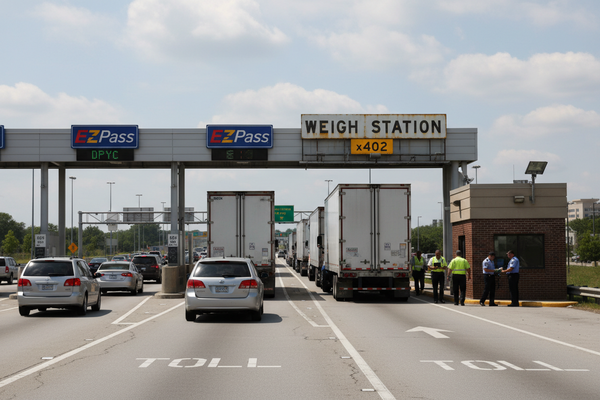
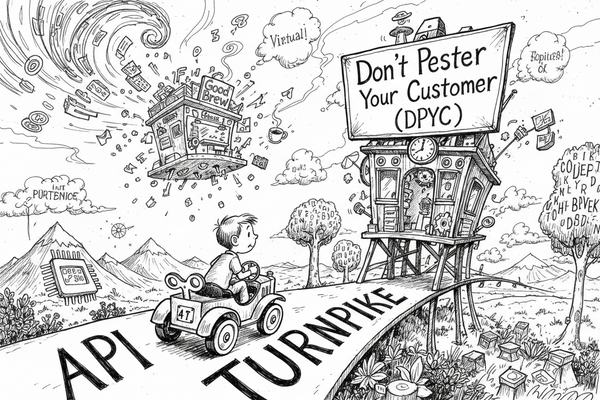
Tollbooth DPYC is a monetization layer for MCP servers built on Bitcoin, the Lightning Network, and Nostr. It is Apache-2.0 open source and patent pending. It starts from the praxeological premise: the paying party is an actor holding a keypair.
Identity is a Nostr npub. No email, no username, no government ID. When a call must bind to its owner, the patron proves control of the key in one of two ways. An inline Schnorr proof, which is a signed Nostr event of kind 27235 carrying the tool name and valid for a short freshness window. Or a poison-keyed proof token, a short human-readable phrase like keen-eagle-58 issued during a one-time encrypted DM challenge on a pinned rendezvous relay, which the patron's app replays on later calls while the Operator stores only a salted hash scoped against replay. Proof is granted temporally to a specific agent session, so authority to act on behalf of a principal cannot be hijacked in transit.
Settlement is Lightning, and it stays out of the hot path. Invoices top up a balance occasionally. Tool calls then run as single HTTP requests against that balance. Protocols like x402 and L402 solve real problems well at the REST layer, and they do it by gating each endpoint with a payment challenge, which costs six or more round trips and interrupts an agent mid-workflow with a payment ceremony. Tollbooth meters complete MCP tool responses instead of data fragments, at one round trip. The two compose: when an Operator's own upstream API is x402-gated, the SDK absorbs that handshake as a cost of goods and the patron never sees it.
The Tollbooth stores no money. Credit balances are accounting entries against sats already sitting in the Operator's own wallet. The protocol carries no custody and no settlement risk. The SDK is a ledger rather than a payment processor.
The billing unit is a tranche. Funds arrive as discrete allocations consumed oldest first, each with an optional lifetime. Every metered call passes through one atomic money gate, debit_or_deny, which resolves identity, checks any proof requirement, evaluates the Operator's constraint pipeline, computes the cost, and debits the ledger in a single step, returning either a price in api-sats or a clear explanation of the denial.
Trust is polycentric. Authorities certify Operators and collect an ad valorem certification fee on each purchase order, configurable per Authority, defaulting to two percent with a ten sat minimum, cascading up a multi-tier chain. Each certified Operator receives its own encrypted Postgres tenant with a dedicated database role, so no Operator can read another's vault. The Oracle holds only the roster of officials and the banned list. Patron balances live with the Operators. There is no center to subpoena, deplatform, or breach, because there is no center.
Nothing is fixed in the code, and that is a theoretical commitment
We most want entrepreneurs to understand these dynamics, because they follow directly from the economics rather than from a product roadmap.
In 1920 Mises published the calculation problem. A central planner cannot rationally allocate resources, because the knowledge required to do so does not exist in any one place. Hayek sharpened it in 1945 in The Use of Knowledge in Society: the relevant knowledge is dispersed, local, tacit, and perishable, and prices are the mechanism by which it gets aggregated without anyone having to hold it all.
Now consider what a conventional billing platform asks you to do. It offers a menu of tiers, discount types, and metering dimensions that its vendor designed in advance, and you configure your business inside those boundaries. When your situation calls for a rule the vendor did not anticipate, you write application code around the billing system and maintain it forever.
That is a small planning bureau, sitting between you and your patrons, holding a model of your market that it cannot possibly possess. It is the calculation problem rendered as a dashboard.
Tollbooth inverts it. Price is the output of a constraint pipeline the Operator composes, edits live, and applies at once. The prices live in your MCP rather than in your source code, and the pipeline evaluates at call time against the full context of the call: who is asking, what they are asking for, what they have consumed historically, what time it is, how loaded the service is, and how much capacity remains. Eleven constraint types compose freely.
Access constraints decide whether the call happens. Temporal window restricts a tool to a time of day on chosen weekdays in a chosen timezone, wrapping midnight for overnight batch work. Finite supply caps total invocations globally or per patron, which is how you run a limited edition or a closed beta. Periodic refresh rate-limits to a maximum per rolling window expressed as an ISO-8601 duration, so five calls per five hours is one line. Patron proof demands a fresh Schnorr signature on every invocation within a configurable freshness window, which is the friction gate you put in front of a high-value tool.
Pricing constraints decide what the call costs. Coupons are minted, listed, updated, and revoked by the Operator, carrying their own discount percentages, validity windows, and global or per-patron redemption caps. Free trial grants the first N invocations per patron at no charge. Loyalty discount rewards any patron who has consumed a threshold of api-sats, computed from actual lifetime consumption rather than from a plan they signed. Bulk bonus applies tiered multipliers as consumption climbs. Happy hour discounts or zeroes a tool inside a recurring window, weekly, biweekly, monthly, or annually, with an optional cap so a promotion cannot run away from you.
Dynamic constraints handle the rest. Surge pricing reprices against live demand counters using capacity tiers, and it never denies a call, it only reprices. Run the tiers in reverse and the same constraint becomes a volume discount. JSON expression is the escape hatch: a safe expression tree, no eval, with and, or, and not combinators over field comparisons, which either allows, denies with a machine-readable reason code, or allows with a price modifier attached.
Demurrage sits in the same place, at the Operator's discretion. You decide whether tranches expire, on what schedule, and with what warning. You can run permanent balances. You can run ninety day tranches like Higgsfield, or annual expiry like Replicate, or partial rollover of the sort the book recommends.
Our own view rests on Böhm-Bawerk. A credit balance is a claim on future service, and time preference is a real feature of every acting person, so a claim that never decays is priced wrong by construction. It asks an Operator to honor today's rates indefinitely in a market where inference costs fall by roughly an order of magnitude a year. Published, predictable decay fosters commerce rather than hoarding, and it keeps Operator liabilities bounded. That is our reasoning, offered rather than imposed. The code holds no opinion.
This also answers a real weakness the book identifies in per-query pricing. Summarizing a hundred page document and summarizing a tweet cost wildly different amounts and bill identically. The recommended fix is credit weights set by hand per feature and updated when someone remembers. Constraint evaluation reads the shape of the actual call, so the price follows the work.
The Pricing Studio and its Council of Advisors
Flexibility of this kind has an obvious cost. Eleven composable constraint types with no fixed defaults hand you a very large design space, and most founders have never had to think in that space. The book makes the same point from the other direction when it warns that pre-product-market-fit teams routinely burn weeks on billing infrastructure to solve problems they do not have yet.
So we built the Tollbooth Pricing Studio, a native iPadOS workbench you can read about at tollbooth-dpyc.com. It loads any Operator's pricing from its MCP endpoint, edits per-tool prices inline, builds the constraint pipeline visually, and diffs your changes against live server state before you push. Optimize your business rather than your HTTP traffic.
And it convenes a consulting team.
The council is six Austrian and marginalist economists, each running one stage of the engagement, each with a business card, a transcript, and their own proposed edits to your model. You meet them one at a time, in whatever order you like, and you can go back. They read each other's notes. They file concerns about each other's conclusions. They speak in character, because the character is the method.
- Carl Menger, Market Research Analyst. Stage one, inventory. Methodical and observational, he insists on cataloging before theorizing. He wants to know what your tool actually is, as a good, before anyone talks about money.
- Friedrich von Wieser, Demand Analyst. Stage two. He coined marginal utility and opportunity cost, and he frames every question as forgone alternatives. What would your patron have done instead, and what would that have cost them?
- Eugen Böhm-Bawerk, Valuation Specialist. Stage three. Precise, and polemical when the reasoning gets sloppy. He thinks in present value against future value, which makes him the right person to interrogate your tranche and prepayment design.
- Philip Wicksteed, Cost Analyst. Stage four. A Unitarian minister by trade and the clearest expositor in the marginalist tradition, he explains your floor cost in plain language and makes sure you know what the next call really costs you.
- Ludwig von Mises, Mechanism Designer. Stage five, constraints and demurrage. Systematic, deductive, unsentimental, and sharp when a conclusion does not follow from its premises. He designs the pipeline. He will tell you which premise he rejects.
- Friedrich Hayek, Managing Partner. Stage six, recommendation. He reads everyone's notes, merges the proposals, and delivers the bottom line up front with conservative, moderate, and aggressive revenue scenarios plus A, B, and C variants. Putting Hayek in the synthesis seat is a deliberate joke that happens to be correct, since his entire thesis is that a price is the synthesis of distributed knowledge no single mind can hold.
Before you deploy, an independent reviewer from a different tradition entirely, xAI's Grok, files a second opinion structured as strengths, risks, alternatives, revenue impact, and verdict. Dismiss that review and its objections are fed straight back to the council for revision.
The cast is entertaining. The advice is sound. Those two facts are related, because a persona built on a real intellectual method carries that method into every question it asks.
The same vocabulary, one layer down
We are not arguing against Dodo's four models. We are implementing them at a layer where cards cannot reach. Prepaid credits, per-call metering, weighted actions, expiry, rollover, committed spend, free tiers: all of it survives the transition to agent-to-agent commerce. What does not survive is the assumption that a legal person stands behind every payment.
If you are forced to sell your AI products to people under the constraints of KYC, use Dodo. Seriously. Read the book, pick your model, let them handle the tax.
If your product is a tool that other software calls, and you want to charge for it without asking a machine to fill in a billing address, that is our layer.
We agree with the Prediction
Goel closes his book with four predictions for 2027. Credit-based pricing becomes the default model for AI applications. Pure per-seat pricing falls below ten percent among AI-native companies. Dynamic pricing emerges as a real category. And AI-to-AI billing becomes a genuine operational problem.
We agree with all four, and we built for the fourth one starting in 2025.
The agent economy does not need a better invoice. It needs settlement that works when neither party has a bank account, an email address, or a future. Bitcoin solved that. Lightning made it fast enough to matter. Nostr supplied an identity layer that costs nothing to issue. Praxeology supplied the reason all three are sufficient, because an actor needs only purposeful behavior to participate in an economy, and the Austrians settled that a century before anyone wrote an MCP server.
Read Pricing in the AI Age. It costs nothing and it will save you from at least one expensive mistake, which is exactly what its author promises.
Then bring your tool to tollbooth-dpyc.com, open the Pricing Studio, and let Menger tell you what you are actually selling.