Capital and Interest is Böhm-Bawerk's magnum opus and one of the greatest achievements in the history of economic thought. It is, in Hans Sennholz's phrase, a Magna Carta of the capitalistic production process. In an economic order built on production, income from capital investment provides the basis of the whole system and a livelihood for a large middle class as well as for capitalists and entrepreneurs. Every judgment about the nature and worth of capitalism turns on how that capital income is explained.
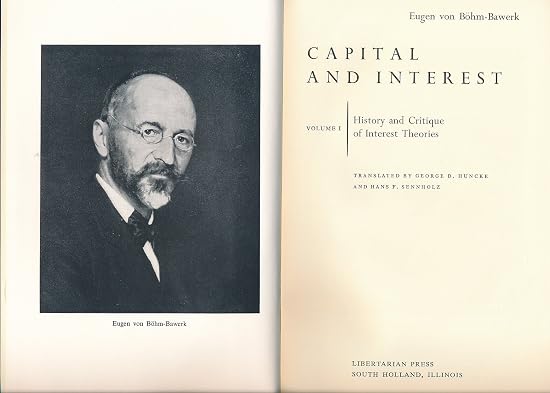
This is the three-in-one edition: the complete work in a single volume, translated by George D. Huncke and edited by Hans F. Sennholz for Libertarian Press.
- Volume I, History and Critique of Interest Theories — a diligent and persuasive analysis of virtually every theory of capital income ever advanced, whether in defense of interest or against it.
- Volume II, Positive Theory of Capital — far more than the title suggests. It presents a comprehensive theory of the entire production process and the principles governing the allocation of interest, wage, and profit.
- Volume III, Further Essays on Capital and Interest — fourteen briefs explaining, elaborating, and defending the Positive Theory, among them "The Role of Disutility in the Value Theory" and "The Size of the Initial Fund That is Necessary for a Given Production Period."
Volume II is the one that changed how economists think about time. Böhm-Bawerk demonstrated in 1889 that a good available today is worth more than the identical good available next week, and that the same good next week is worth more than one available next year. From that single observation he derived the whole phenomenon of interest — not as a creation of banks or lenders, but as a fact of human valuation. Mises later named the gap originary interest and placed it beneath every rate ever quoted.
The same volume gives us Produktionsumweg, the roundabout method of production: the argument that a longer, more capital-intensive route to a finished good yields more than the direct one. Build the net before you fish. It is the reason capital exists at all, and the reason waiting is productive rather than merely patient.
Two of our coffees are named for arguments made in this book. If you have read the tin and wanted the source, this is it.
On price, and buying wisely. This title has been out of print for some years, and it trades on the secondary market. Copies move between roughly fifty and a hundred dollars depending on condition, binding, and the seller's mood that week. The figure shown here is indicative only. We send you to the listings; we do not set the price and we do not hold the stock.
Caveat emptor. Read the seller ratings, read the condition notes, and compare the offers before you commit. A used copy in good condition is often the better buy, and sometimes the only one available. Check also that you are getting the three-in-one volume rather than a single volume of the set — the listings are easy to confuse.
Avoid the cheap public-domain reprints of the 1891 Smart translation. Several circulate in oversized single-column formats with no publisher information, and reviewers describe them as genuinely difficult to read. The Libertarian Press edition, Huncke translation, is the one to own.