A country gentleman sells off parcels of land to buy books, reads himself out of his wits, and rides out to restore a world that never existed. It is the first modern novel and still one of the funniest. It is also, on a reading that has been gaining ground among Austrian scholars, a book about money.
The case for shelving it here. Eric Graf, writing in the Quarterly Journal of Austrian Economics, argues that Don Quijote is steeped in the thinking of the School of Salamanca, and that the decisive influence is not Erasmus — the standard reading — but Juan de Mariana, the Jesuit who was the leading Salamancan of the day. His conclusion is blunt: the novel should be taught in every economics department.
The timing is what makes it hard to dismiss. Mariana's De rege appeared in a second edition in 1605 carrying one new chapter, De moneta, attacking the debasement of the coinage. Part One of Don Quijote was published the same year. Mariana expanded that chapter into De monetae mutatione in 1609, had to print it in Cologne, and was arrested and tried for lèse-majesté. Graf's thesis is that some version of the 1605 chapter is the likeliest source for Cervantes's persistent attention to monetary manipulation.
Once you are looking for it, the coinage is everywhere: the description of Rocinante's hooves in the opening chapter, the robbery and adultery running through the Sierra Morena episodes, Sancho's slaver fantasy, the adventure with the lions, the three cases Governor Sancho adjudicates on the Isle of Barataria. Queen Maguntia, in Part Two, is Mainz — where Mariana published the edition that carried the money chapter.
And there is the madness itself. Mariana's Historia de España had reassessed the kings of Spain by the metallic content of their coins, and heroes and villains swapped places accordingly: Alfonso the Wise had misrepresented his coinage, while Pedro the Cruel's was sound. Graf's reading is that the knight's derangement owes much to the ideological disorientation of a country that had lived through centuries of monetary manipulation. A man who can no longer tell a windmill from a giant is the citizen of a realm where the coin in his hand no longer means what it says.
Cervantes was not writing economics. He was writing the society the economists were describing — an impoverished gentry that cannot afford its own dignity, innkeepers and muleteers scraping by, a squire promised an island in payment.
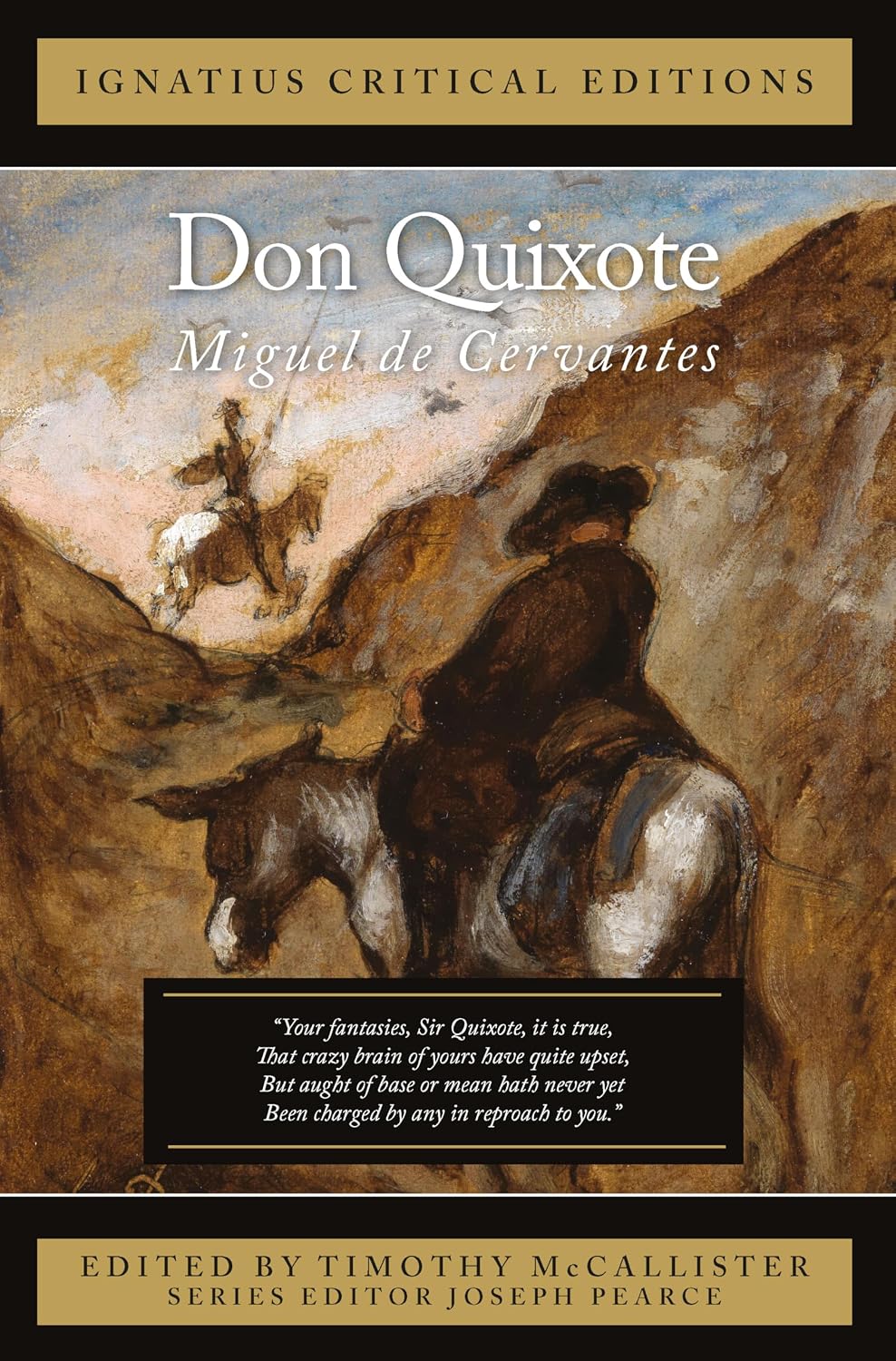
This edition. The Ignatius Critical Edition, edited by Joseph Pearce and Timothy McCallister, with essays by Michael McGrath, Kathleen Sullivan, Michael Dominic Taylor and R.V. Young. Pearce is the general editor of the series and the biographer of Tolkien, Lewis, Chesterton and Solzhenitsyn, and the series exists to read the classics from within the tradition that produced them rather than against it.
That is the right instrument for this particular book. Cervantes was a Catholic writing in Counter-Reformation Spain, and the thinkers whose arguments run through the novel were friars and Jesuits — Mariana above all. An edition that takes the theology seriously is reading Cervantes in his own terms, which is also, as it happens, how you get at the economics. 920 pages, complete.