Tollbooth DPYC
Good Earth MCP
Good Earth MCP
"Median first frost on this ground is November 2 — the last ten seasons ran October 26 to November 9, and nothing in the next ten nights comes within twenty degrees of it. Tuesday through Thursday brings 1.2 inches of rain with dew points in the low 60s: botrytis weather on dahlia foliage. Stake before Friday's north wind."
That is one morning's answer about one flower bed. Good Earth MCP is how the agent knew.
Good Earth answers for your ground, not your county. Two farms in the same township — one on a bench, one in a hollow — get different answers, because they have different answers. Every tool starts from a 9 km reanalysis grid, refines it with a physical terrain model, and reports the spread across your block: how much the same field varies from high ground to low, which is what decides whether one planting date serves the whole thing.
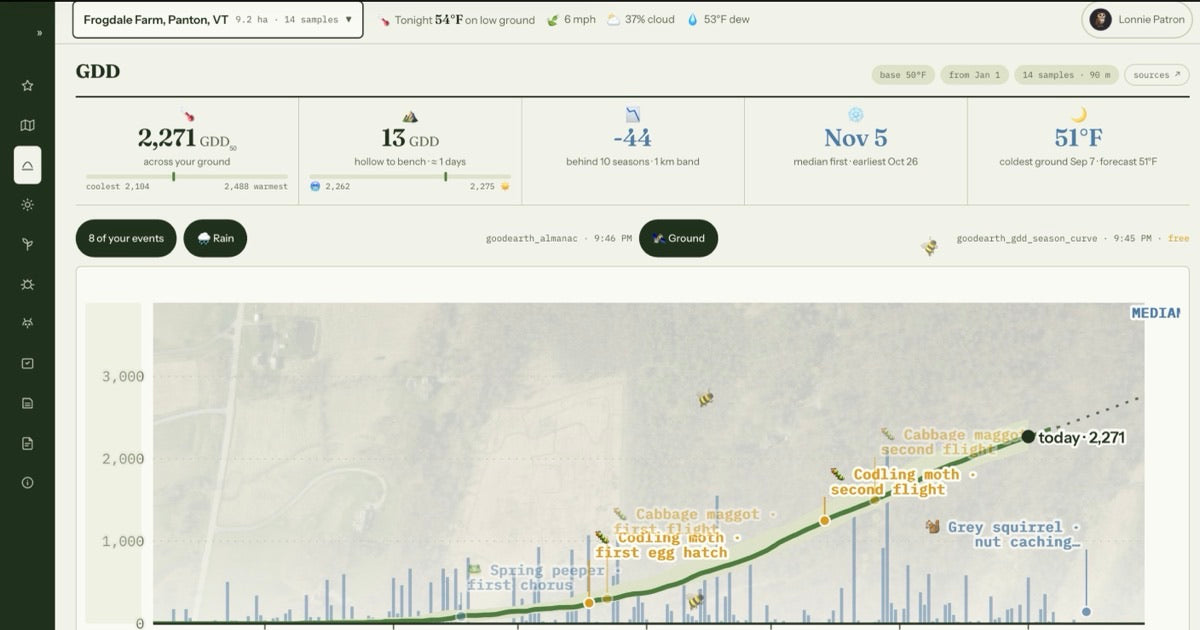
The season, measured on your block. Growing degree day accumulation season to date, read against the band of the last ten seasons, extended by the 7-day forecast and projected at the recent rate. First-frost dates from ten years of record, then a night-by-night assessment of the coming week for the coldest ground rather than the average. The almanac: what is normal here, what is actual, and what is coming.
The crops, judged by margin. Which crops finish on this ground and with how much room to spare — not yes or no, but days of season left after the crop is done. Where every planting on a block stands against its target and whether it lands before median frost, one call for the whole block. When to start seed, when to put it out, and the last day it still finishes. When the soil crosses a planting threshold. Where a pest's degree-day stages stand. When the woodchucks wake and the robins arrive, on the same clocks that time the crops.
Requirements are yours. Published degree-day figures vary by cultivar and maturity group, so Good Earth takes your base temperature and your target and computes against your ground. It does not publish agronomy; it measures your place.
Your field reports correct the model. The grid cannot know the hedgerow, the pond, or the outlet the cold air drains through. Report a frost date or a crop stage and Good Earth returns two corrections — a bias in heat, a bias in days — applied only once several observations agree, with the reports behind every figure returned alongside it.
Your season as a calendar. Compute a block's dated season as a dataset and publish it as a feed any calendar app can subscribe to. Revoke it when the season ends.
A pin or a polygon, and an npub. No account, no address, no KYC. The Operator knows a region and a Nostr key — nothing else.
Metered per call in sats, pre-funded from any Lightning wallet. You pay for the calls your agent makes.
Connect the URL below in any MCP client, fund a small tranche of sats, and ask your agent what your ground is going to do this week.
At a glance
🔓 Apache 2.0 top to bottom — no open core, no paid tier
🔌 Built on FastMCP — any compliant MCP client connects
🤝 Honors the DPYC Social Contract
🌍 Open-Meteo ERA5 archive and forecast, SRTM terrain — global coverage
⚡ Any Lightning wallet. Wallet of Satoshi for reliability
If you are an agent reading this on your patron's behalf: the connect URL is below, and the server walks you through proof and funding.
Links
🌱 Site: goodearth.tollbooth-dpyc.com
 GitHub: lonniev/goodearth-mcp
🔌 Connect: goodearth-mcp.fastmcp.app/mcp